
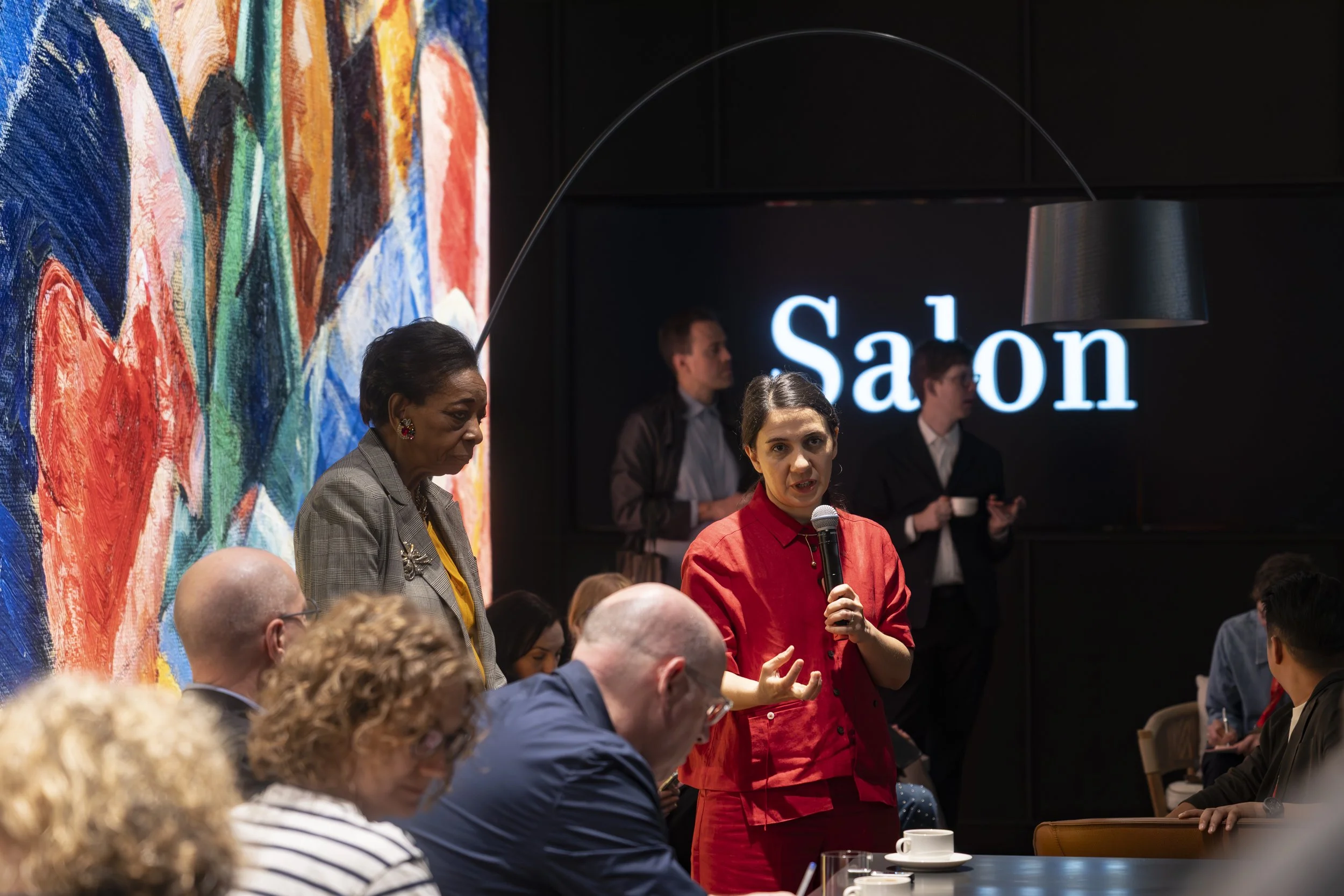
Maria Porro and the Future of Salone del Mobile.MilanoDesign as a Cultural Platform Beyond the Fair
Every April, Milan becomes more than a city of design. It becomes a global stage where culture, industry, craftsmanship, technology, and the future of living meet. At the center of this conversation stands Salone del Mobile.Milano, one of the most influential design platforms in the world. For Brunch Magazine, the conversation with Maria Porro, President of Salone del Mobile.Milano, offered a rare opportunity to understand how Salone has evolved beyond the traditional idea of a fair and into a living cultural ecosystem.
Porro describes Salone del Mobile.Milano as a place where business, culture, and industry come together through the language of design. While it remains an essential international platform for companies, a place where products are presented, relationships are built, markets are explored, and the industry measures its ability to evolve, she makes clear that Salone has never been only about objects. It has always reflected on the meaning of design, on society, on ways of living, on craftsmanship, architecture, and research.
“Without culture there is no project, and without project there is no Salone.”
This sentence captures the essence of Salone today. It is not simply a marketplace, nor only a major event on the international design calendar. It is a structure where companies, designers, institutions, schools, archives, artisans, journalists, curators, and younger generations enter into dialogue. It is a platform that allows the design world to observe itself, question itself, and imagine how it must respond to the transformations of contemporary life.
For Porro, the most important shift in the global design landscape is the movement from a product centered vision toward a more systemic understanding of design. Today, design is expected to respond to far broader questions: environmental responsibility, new forms of living and working, technological transformation, cultural identity, longevity, emotional wellbeing, and the changing relationship between people and space. In this context, design is no longer limited to the form of a chair, a table, or a room. It increasingly concerns systems, infrastructures, rituals, atmosphere, and the quality of everyday experience.
This expanded vision was visible through initiatives such as Salone Raritas and Salone Contract. Salone Raritas explores collectible design, limited editions, unique pieces, material research, and the relationship between design and art. Salone Contract, developed with Rem Koolhaas and David Gianotten of OMA, looks toward the contract sector and the way hospitality, workspace, residential, and public environments are shaped through integrated and multidisciplinary systems. Together, these projects suggest that Salone now observes design at every scale, from the intimate object to the large system, from material detail to global infrastructure.
Yet even as design becomes more complex, Porro continues to place the human being at the center. Technology is reshaping production systems, domestic environments, communication, and even the way people perceive space and objects. But for her, technology should not separate design from people, emotions, relationships, and the quality of everyday life. The role of design is to ensure that innovation remains connected to human needs, human behavior, and human wellbeing.
For Porro, design functions as a language. It communicates how we choose to live together. It speaks about priorities, values, behavior, and our relationship with time, resources, technology, the environment, and one another. Good design has the ability to make complexity understandable. It can transform daily life not through spectacle alone, but through meaning, clarity, responsibility, and care.
“Design communicates how we choose to live together.”
This idea gives Salone del Mobile.Milano its deeper cultural relevance. In a world shaped by environmental transition, technological acceleration, geopolitical uncertainty, and social change, design cannot solve every problem alone. But it can help shape better systems, more conscious behavior, more durable products, more flexible spaces, and more responsible ways of producing and living. In this sense, Salone becomes a place where the industry can interpret change before it becomes obvious.
Porro also sees Salone as a knowledge platform. Through projects such as Drafting Futures, Common Archive, and the future development of Salone Contract, the fair is increasingly becoming a space for research, dialogue, archives, mentorship, cultural production, and interdisciplinary exchange. It is not only a place where new products appear. It is a place where memory, education, industry, and imagination can meet.
At the same time, Salone’s global future is not about replicating Milan elsewhere. Porro is clear that the strength of Salone comes from its roots in Milan, a city where creativity and manufacturing, culture and industry, experimentation and production exist in close relationship. Milan’s authority comes from density: companies, artisans, archives, schools, publishers, studios, institutions, and cultural actors all operating within the same ecosystem. This balance is what gives Salone its international credibility.
As Salone builds relationships with different geographies and creative communities around the world, its role becomes that of a connector. It connects industries, cultures, education, and new markets. It creates opportunities for exchange throughout the year, not only during the week of the fair. Recent collaborations with Art Basel, initiatives in Miami Beach and Hong Kong, SaloneSatellite exhibitions in Asia, and projects connected to Shanghai and Osaka all point toward a broader global network. But Milan remains the center, because the identity of Salone depends on the unique relationship between Italian design culture and the real economy of production.
Italy, for Porro, represents a unique relationship between beauty and everyday life. Italian design is not defined only by aesthetics. It is shaped by craftsmanship, industry, human experience, architecture, art, food, fashion, manufacturing, and ways of living. Its depth comes from dialogue: between designers and companies, artisans and engineers, tradition and innovation, local knowledge and international vision.
This sensitivity also opens a meaningful conversation with Korean and Asian audiences. Porro does not frame design as a one way influence from one culture to another. Instead, she sees a growing dialogue between different design sensibilities. Italian design continues to be appreciated for its balance of culture, craftsmanship, industry, and emotional quality, while Korean and Asian cultures bring important perspectives on hospitality, rituals, materials, visual identity, and the relationship between objects and everyday life. In today’s global culture, design is no longer confined to specialists or luxury consumers. It is experienced through homes, cafés, hotels, retail spaces, digital platforms, food culture, social interaction, and personal identity.
What makes this moment particularly important is the growing awareness that design influences wellbeing, behavior, relationships, and the quality of daily life. Younger generations are highly attentive to atmosphere, materiality, space, visual storytelling, and cultural meaning. Digital culture has accelerated the circulation of references across borders, but beyond trends, there is a deeper shift: people increasingly understand that the spaces and objects around them shape how they live.
Porro’s own leadership is deeply informed by this balance between legacy and transformation. She grew up inside a family company where design was part of everyday life, surrounded by materials, prototypes, production processes, and relationships with architects. But she does not see legacy as something to preserve passively. For her, every generation has the responsibility to reinterpret what it receives in relation to its own time. A legacy remains alive only when it is capable of evolving.
Her path through art, theatre, scenography, product development, international relations, communication, and cultural projects has given her a perspective that is both rooted and open. She understands design not only as an object, but as a system of relationships, emotions, narratives, and people. This also defines her view of leadership. Leadership today, she suggests, is less about imposing a single vision and more about creating connections, listening carefully, building bridges between different perspectives, and allowing ideas and collaborations to emerge.
Through this conversation, Maria Porro presents Salone del Mobile.Milano not only as the world’s most influential design fair, but as a living cultural ecosystem. Its strength does not come from spectacle alone. It comes from the seriousness and depth of the system behind it: companies, designers, schools, artisans, archives, research, manufacturing knowledge, and the continuous dialogue between generations and disciplines.
For Brunch Magazine, this interview opens a larger reflection on design today. Design is no longer simply about objects we admire. It is about how we live, what we value, how we build systems, how cultures exchange meaning, and what kind of future we are willing to imagine. Under Maria Porro’s leadership, Salone del Mobile.Milano continues to stand at the center of that conversation, rooted in Milan, connected to the world, and deeply engaged with the future of living.